Decision aid prototype for healthcare research
Nuffield Department of Primary Care Health Sciences
Impact
We translated complex medical data into patient-friendly interfaces for primary care.
Enabled evidence-based validation: We provided the Department with realistic interface concepts to test complex medical data with patients and clinicians before investing further in development.
Bridged the communication gap: Transformed a complex clinical calculator into a practical communication aid by embedding plain-English conversational scripts that help clinicians explain statistical risks to patients seamlessly.
Drove internal alignment and momentum: The mock-ups immediately sparked thoughtful strategic discussions among the project team and stakeholders, generating excitement and high confidence for the upcoming qualitative interview phase.
Fruto were a delight to work with and generated some fantastic preliminary design ideas for our project. We're enthusiastic about working with them as our projects progress.
About Nuffield Department of Primary Care Health Sciences
The Nuffield Department of Primary Care Health Sciences, part of the Medical Sciences Division at the University of Oxford, is a leading research institute. The Department focuses on improving healthcare delivery, clinical workflows, and patient outcomes by developing robust, evidence-based tools and interventions for primary care.
What they needed
The Department collected extensive scientific research data on the personalised risks and benefits of antihypertensive medications and sought to translate this into a digital decision aid for shared decision-making in primary care.
The main challenge was to present complex, personalised risk factors in a clear, accessible format that empowered patients to make well-informed decisions and helped clinicians communicate effectively, often within a time-sensitive consultation. They also had to account for consultations occasionally being conducted remotely over the phone by non-GPs, such as clinical pharmacists or healthcare assistants.
The Department needed to ensure that the presentation of statistical risks and benefits was entirely neutral, avoiding positive or negative framing that might unconsciously bias a patient's choices. And the interface had to cater to a dual audience: providing robust data for the clinician while acting as an empathetic communication aid for the patient.
The Department required an efficient way to visualise their data for use in upcoming focus groups and think-aloud interviews. They also needed to determine whether the new tool should be integrated into GP Evidence, an established digital resource trusted by clinicians, to avoid further fragmentation of digital tools.
What we did for them
Fruto worked closely with the Department, applying practical expertise in UX design and product strategy to address the unique challenges of healthcare.
We began by facilitating a collaborative session to sketch a high-level page flow mapping clinician and patient navigation, decision points, and data inputs. Our focus on information architecture ensured a balance between the detailed clinical evidence required by GPs and a simplified, intuitive information flow for patients.
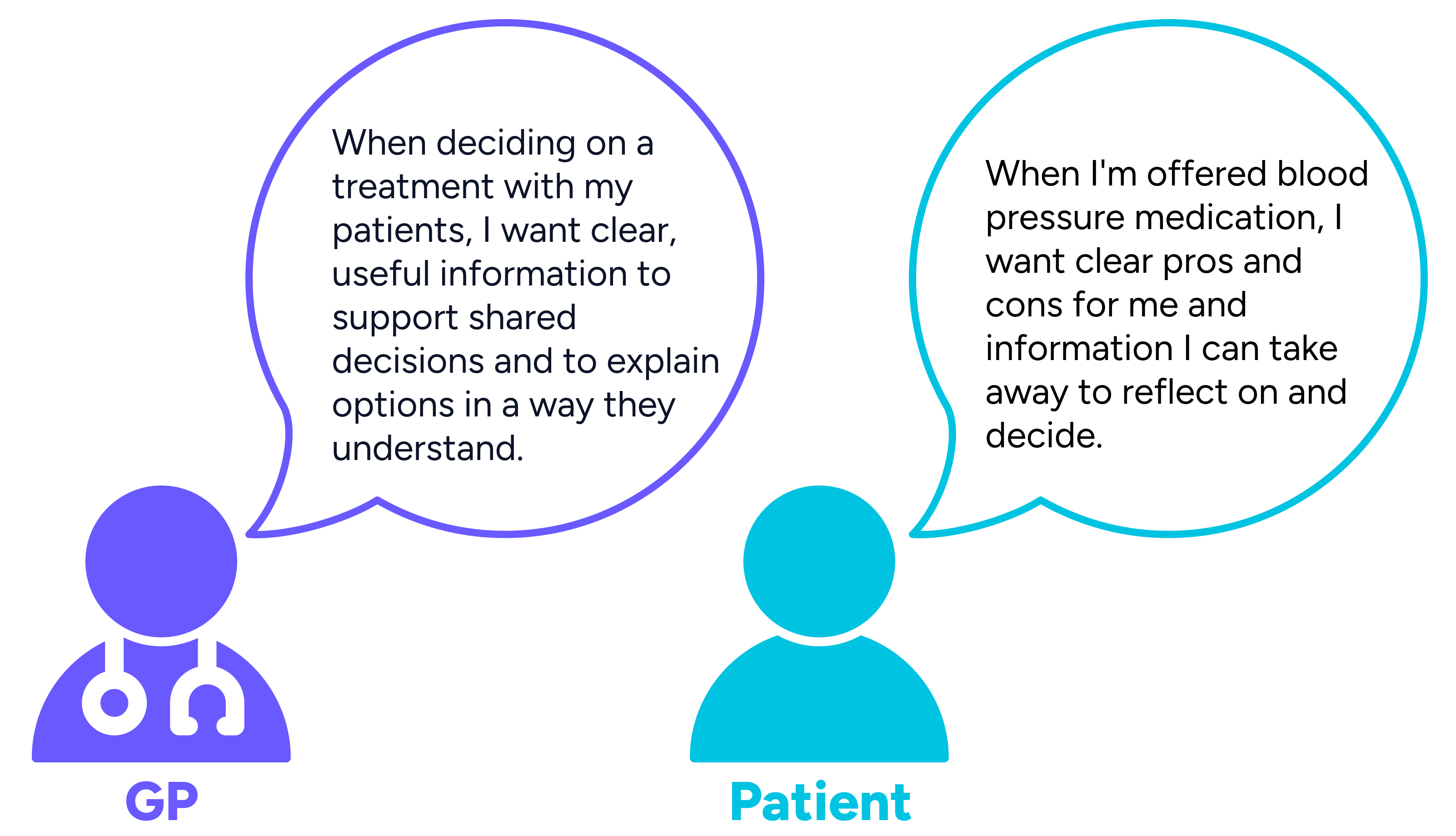
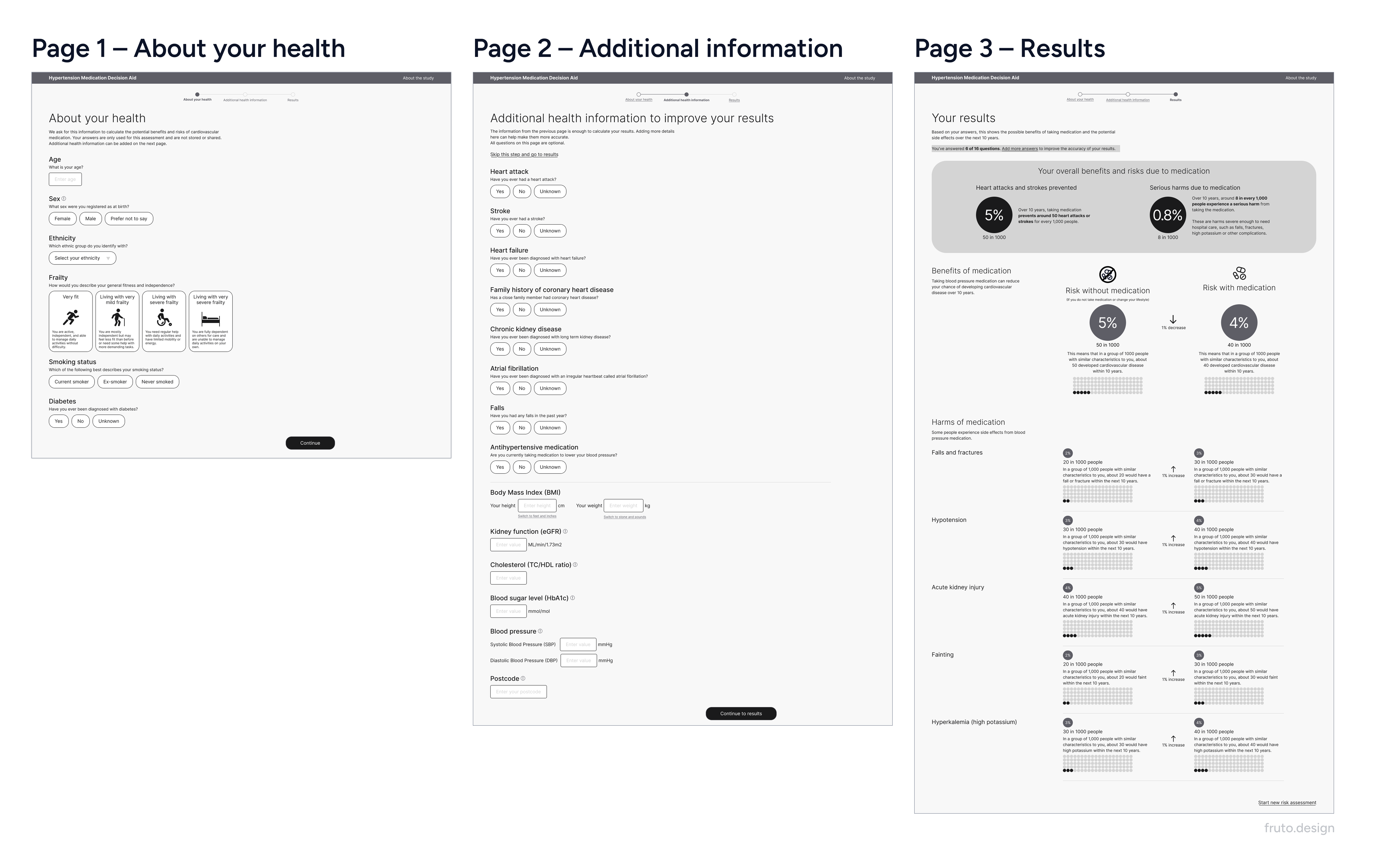
We then designed early-stage interface concepts, exploring various methods for presenting information, guiding data personalisation, and communicating medical results.
To enable quick data entry, we used progressive disclosure: a short list of essential inputs with optional fields for detail. Clinicians could add information as needed without feeling overwhelmed.
We prioritised conversational design and plain English, replacing acronyms like "eGFR" with "kidney function" and "HbA1c" with "average blood sugar level."
To ease cognitive load and time pressure on doctors, we embedded conversational phrasing in the interface, giving clinicians a ready-made script for explaining personalised data.
We presented the benefits and harms of medication with equal emphasis to support unbiased, shared decision-making.
These concepts were intentionally lightweight to keep the project efficient while providing sufficient detail for qualitative testing.
Results
The Nuffield Department received clear, testable concept screens that effectively translated its academic data into realistic digital healthcare interfaces.
These visualisations equipped their research and behaviour scientist team to run meaningful focus groups and think-aloud interviews with clinicians and diverse patient communities.
After the research phase, Fruto ran a debrief to discuss what resonated with doctors and patients and guide the next iteration.
Ultimately, our evidence-led design approach ensured that future development would be grounded in validated user needs, eliminating customer blind spots and significantly reducing the risk of developing an ineffective clinical tool.